 The Perimenopause Husband
Does Perimenopause Make You Hate Your Husband? His Side
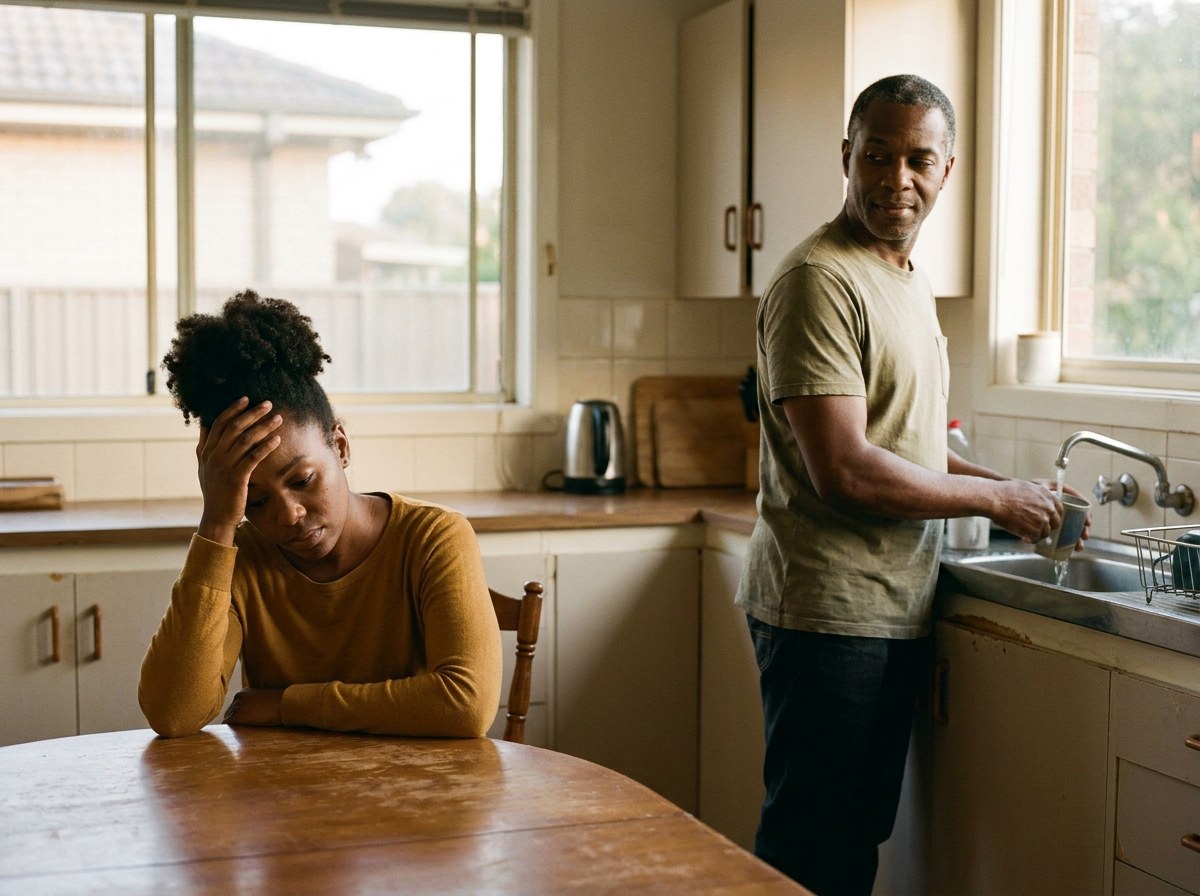
Does perimenopause make you hate your husband.
If you've typed that, I'm the husband. Not yours. But I stood where he's standing, for a couple of years, and I'd like to tell you what it looked like from my side of the kitchen.
It looked like nothing I did was right. After a while, it looked like being in the room was wrong too.
What does it feel like from his side?
Here's the honest version.
It wasn't really about whether I'd done something. It was about me being there at all. My wife could be in a room, having a hard day, and my walking into it was enough. Not a word out of me. Just there.
I didn't have a word for that. So I had two reads instead, and both were wrong. One, I'd done something and had to find it. Two, she'd gone off me. For a long time I swapped between the two depending on the day, and neither one left me anywhere useful.
What was actually happening had almost nothing to do with me. Her system was running hot, and whatever was in front of her in that moment became the thing it landed on. It would have landed on something. That day, it was me.
Is it perimenopause, or is it him?
I'm not a doctor, and I'll keep this simple. Two of the big hormones, oestrogen and progesterone, rise and fall with no warning and no pattern through these years. They have a hand in her mood, her sleep, her memory and her body's thermostat. When they go quiet, the patience goes with them, and the person closest to her gets the first of it.
That's not the same as saying he's blameless. If he's genuinely not pulling his weight, or he's answering every hard day with a harder one, perimenopause doesn't excuse him any more than it excuses her. Respect runs both ways. Bad behaviour from either side isn't okay, and understanding something isn't the same as accepting it.
But if what you can't stand is the sound of him breathing, or the way he put a cup down, that's not him. That's your senses turned up, and he's the nearest noise.
If it's wearing you down, that's a doctor or a specialist in this field. Take him with you, if you want him there.
Why do women say they hate their husbands in perimenopause?
I went and read what women actually say, because I'd only ever heard my own house. Hundreds of comments, and the reasons sort themselves into a short list. I'll give it to you straight, in the order it comes up.
He leaves it all to me. The biggest one by a long way. The mental load, the house, the kids, the bookings, all of it still hers while she's running on nothing, and years of swallowed resentment coming up now the hormones have taken the padding off. Why does he get to just exist, is how one woman put it.
Everything he does is loud. The chewing, the breathing, the sniffing, the packet rustling. It's the single most repeated thing, and it's the whole of the husband comedy you see online. It was the apple in our house.
He doesn't believe it's real, or won't do the reading. The blank look. Having to push him to find out anything. Most women say their partner didn't know enough to help them.
He takes it personally and wants the old her back. He reads her pulling away as rejection when it's overwhelm, and he says he wants the old her, which lands as the new her being wrong.
He pushes for sex, or sulks when he doesn't get it, and she carries the guilt of saying no night after night until it turns into resentment. That one has its own post coming, because it deserves more than a line.
He fixes instead of listening. He asks what's wrong and then answers it himself.
And two that women own. Her own state landing on whoever is in the room, which a lot of women say plainly is not his fault. And, rarer but serious, him using it against her, throwing it back at her in an argument.
That's the list. Nearly all of it is one thing wearing seven coats. He doesn't understand what's happening, so he keeps being himself at full volume in a house that can't take it, and she reads that as not caring. He reads her as hating him. Round it goes.
And what do they say they wish he'd do. Be patient. Don't take it personally. Give a hug. Don't give advice. Just be there and listen. Pitch in before being asked. Read about it. Come to the appointment. One woman's signal for space was I'll be at the bottom of the garden, and his reply was I'll put the kettle on. That's the whole brand in two lines, and neither of us wrote it.
Do you actually hate him?
I can't answer that for you. I can tell you what my wife said to me, years later, about those days. She didn't hate me. She couldn't stand anything, and I was the anything she lived with.
You are not crazy. You're not losing your mind. What's happening is happening to your body and you have no say in it. He needs to hear that too, because from his side it looks a lot like being hated, and a bloke who thinks he's hated does one of two things. He fights, or he leaves the room. Neither helps.
What can you say to him?
Here's one of the tools. There are plenty.
I don't hate you. Today everything is too much, and you're the closest thing to me.
One sentence. Said once, on a day you can get it out. Not as an apology, you don't owe one for weather. As information.
If you can add the second half, add it. You're the safest person I've got, and I know you won't hold this against me. That's what I'd have wanted to hear. It tells him he's not the problem, he's the one you trust with it.
This works best in a house where the two of you could already talk. If you had good communication before perimenopause, this is just that, sharpened for the hard days. If you didn't, this sentence is still a good place to start.
Because here's what he's doing without it. He's going back over the last two days trying to find his crime. He's building a case about whether you still love him. He's deciding, quietly, whether to fight or go quiet. One sentence takes all of that off the table and gives him something he can actually do with his hands, which is give you room.
If you can't say it out loud yet, send him this. That's what the page is for.
What should he do with it?
Give you room without leaving. Don't take the bait on the sharp days. Stop looking for the crime.
What I did once I understood it, and what I say to her now on the hard days, is in the book, in the chapter called When You Feel Like You've Lost Her. He's probably already searched his version of your question. It's the same question. You're just standing at different ends of it.
Does it pass?
The days still come. What passed in our house was the story I told myself about them.
You haven't gone off him. You're in weather he can't see. Send him the forecast.
Send Him the Weather
The Weather Report is the two-page guide to the five weather states, what each one looks like from his side and the one thing to do in it. Free. Send it to him, or print it for the fridge.