 The Perimenopause Husband
The Perimenopause Hormone Chart, Drawn for a Bloke.
The night I went looking, I found hormone charts everywhere. Every one of them was drawn for her, or for her doctor. None of them was drawn for the bloke in the kitchen wondering what just happened.
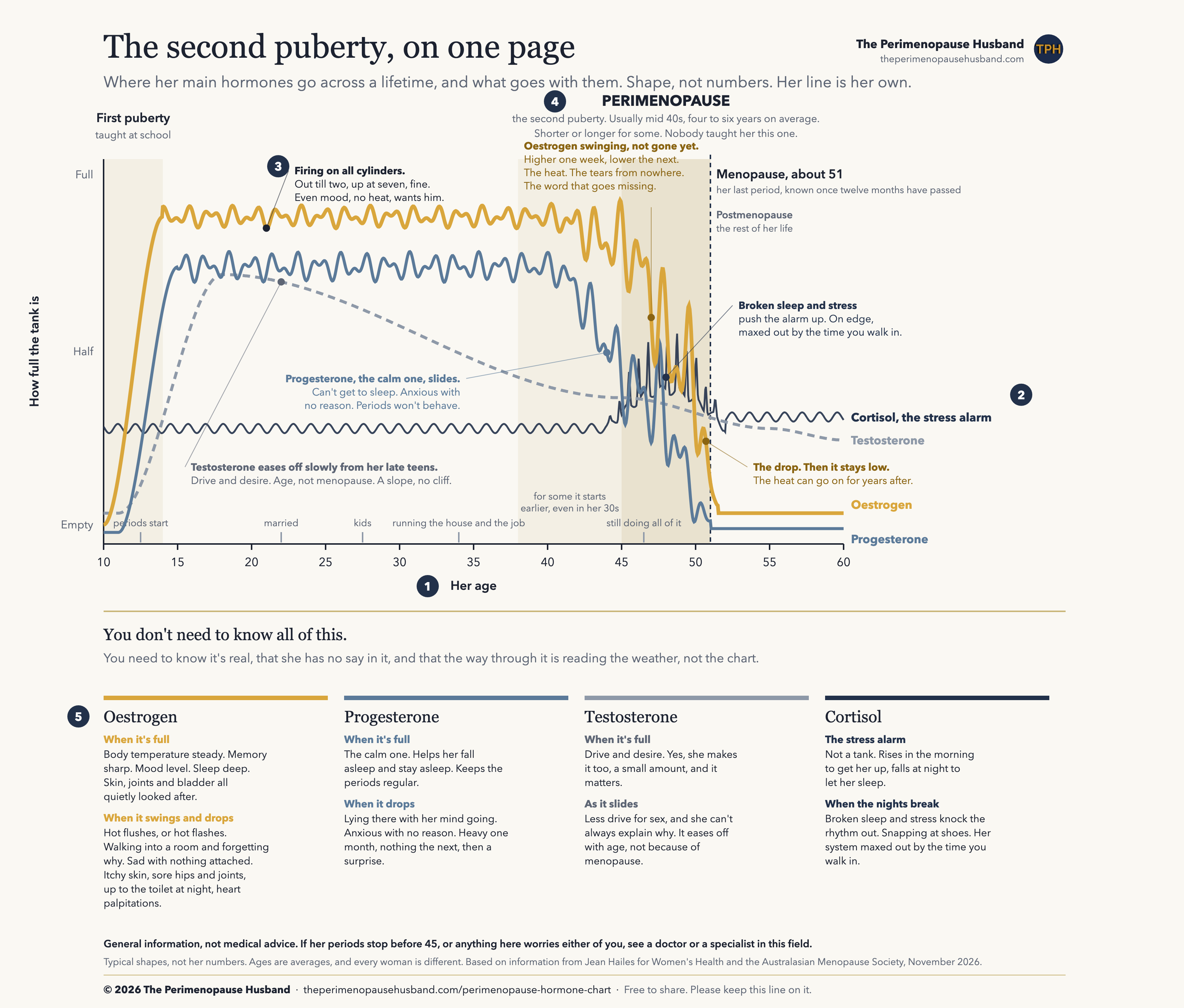
So we drew one. Her four main hormones across her life, from ten to sixty, with the shaded band where perimenopause usually sits. Shape, not numbers.
How to Read It in Thirty Seconds
The numbers below match the numbers in the circles on the chart.
- Along the bottom is her age. The small marks are ordinary life: periods start, married, kids, running the house and the job.
- The four lines are named on the right. Gold is oestrogen, blue is progesterone, the grey dashes are testosterone, and the dark line underneath is cortisol.
- For most of her life the lines bounce, but they hold their level. That's her firing on all cylinders.
- The shaded band is perimenopause, the second puberty. Usually her mid forties, four to six years on average. Watch the gold and the blue. They swing, then they drop, and after menopause at about 51 they stay low. For some women it starts earlier, even in their thirties. That's the lighter band.
- Under the chart, each hormone gets a few plain lines. What it looks after when it's full, and what you see in the house when it swings or drops.
Cortisol is the odd one. It isn't a tank that empties. It's the stress alarm, and the broken nights push it up.
What the Chart Can't Tell You
Which day you're in. The chart is her whole life on one page. Your house is this morning.
That's what the five weather patterns are for: Storm Warning, Overcast, Fog, Clearing and Sunshine. The hormone is the reason. The weather pattern is what you can see from the kitchen.
And it isn't her chart. Her line is her own. If her periods stop before 45, or anything on it worries either of you, see a doctor or a specialist in this field.
If a page of lines isn't how you take things in, Perimenopause Hormones for Husbands walks through each one in words, and what it looks like at home.
If you're here for him
Send him this page. One link, drawn for him, and it tells him the thing he most needs to hear. It's real, and you don't get a say in it.
Start With the Weather
The Weather Report is the two-page guide to reading these days: telling a storm warning from an overcast day from a fog day, and knowing the one thing to do in each. Free, on your phone in thirty seconds.