 The Perimenopause Husband
Perimenopause and Exercise: Move With Her, Don't Coach Her
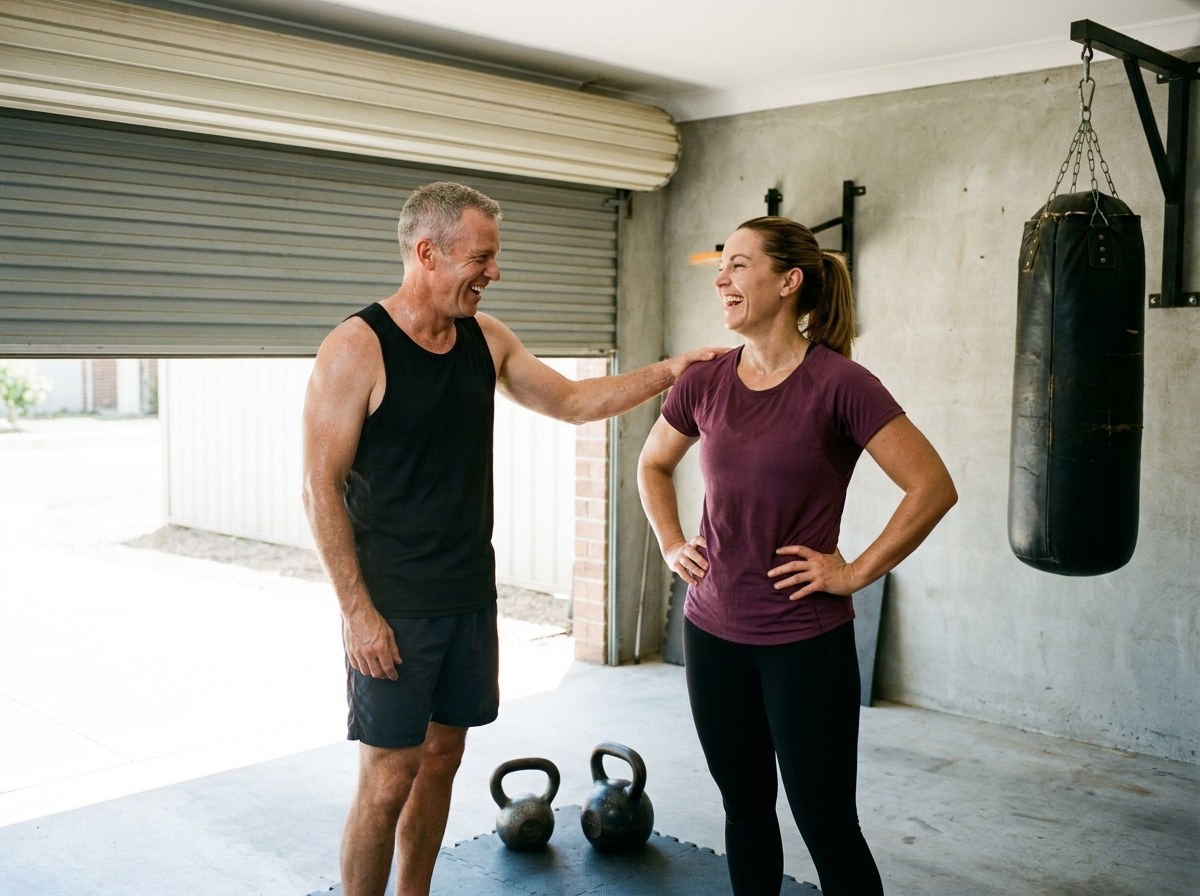
I built a gym at home.
Weights, a bag for boxing, a treadmill, a bike. Everything within arm's reach, twenty steps from the kitchen. The whole family could train in it at once.
My wife drove to a yoga class instead.
Does exercise help with perimenopause?
I'm not a doctor and I'm not going to tell you what exercise does or doesn't do for her body. That's a question for a doctor or a specialist in this field, and it's hers to ask.
I can tell you what it did in our house, which is a different thing. Moving together became one of the more reliable good parts of our week. Not because of what it did to anyone's heart rate. Because of who we were while we did it.
What did I get wrong about her exercise?
I had the setup, so I had the opinion.
We've got a gym right here, I'd say. More than once. Why drive somewhere and pay for a class when everything you need is twenty steps from the kitchen. It seemed obvious to me. It clearly wasn't obvious to her, and for a while that genuinely annoyed me, in a low level way I didn't examine too closely.
Here's what I understand now. I'd built a gym for the way I train. Then I treated it as the way she should train, and made her feel like she had to justify a perfectly reasonable need because it didn't match the setup I'd built.
Why she went to yoga, and what that hour was actually for, has its own post. This one is about the days we do move together, and how I stopped being the coach.
Why doesn't my program work for her?
Because it's yours.
Her body is going through a hormonal, biological change, and it changes the rules without telling either of you. Some weeks she's got everything. Some weeks her hip goes getting out of the car, or her shoulder locks up so she can't reach the top shelf, and the wrong read is you slept funny, you've pulled something, push through.
A program assumes the same body turns up every session. Hers doesn't. So a program written by the bloke whose body does turn up the same every session is a program she'll fail, through no fault of her own, and then it's one more thing she's failing.
The scales already do that to her. She doesn't need the garage doing it too.
How do we exercise together?
Here's one of the tools. There are plenty.
Train together, not side by side. One weight for her, one for you, twenty minutes.
Not her on the bike while you do your thing on the bag. Not two programs in the same room. The same session, scaled to the body that turned up today. A couple of kettlebells, one weight for her and one for me, twenty minutes in our own home gym, and we're both wrecked in the good way.
And when the body changes the rules, the session changes. A slow walk instead of the big one. On the bloated days, a slow walk after dinner, which helps her, helps me, and nobody has to talk about why.
The point is not the training. The point is that she's never training against your standard, and she's never doing it alone unless she wants to.
How that balance settled in our house, the gym some days and the beach most weeks, and what I say now instead of we've got a gym right here, is in the book. The chapter is called Moving Together.
Should I push her to exercise?
No.
If she wants the class, the walk with her friend, the hour that's hers, the answer is yes and the answer is quick. If she wants company, you're company, at her pace. If she wants neither this week, that's information about the week, not a failure of discipline.
The bloke who pushes gets a wife who exercises less and resents it. I know, because for a while I was him.
Did it change anything?
Without a question of a doubt. Exercise has changed things in our house for the better, and I'd say that to any bloke.
It's a habit now, and we do most of it together. We plan the walks and we plan the weight sessions, and when we can make the opportunity we take it. When one of us does a walk or a session on their own because of what the day has in it, nobody holds it against the other. That's the balance.
We can both genuinely feel the difference. It helps the sleep, it helps the mood, and it takes the edge off some of the other things people in these years struggle with. What we eat changed alongside it, and that's a post of its own.
What changed wasn't her fitness or mine. It was that moving stopped being one more place she had to justify herself, and became one of the few places she didn't, and that we did it beside each other.
Start With the Weather
The Weather Report is the two-page guide to reading these days: telling a storm warning from an overcast day from a fog day, and knowing the one thing to do in each. Free, on your phone in thirty seconds.