 The Perimenopause Husband
A Perimenopause Tracker for Husbands: Why We Built One
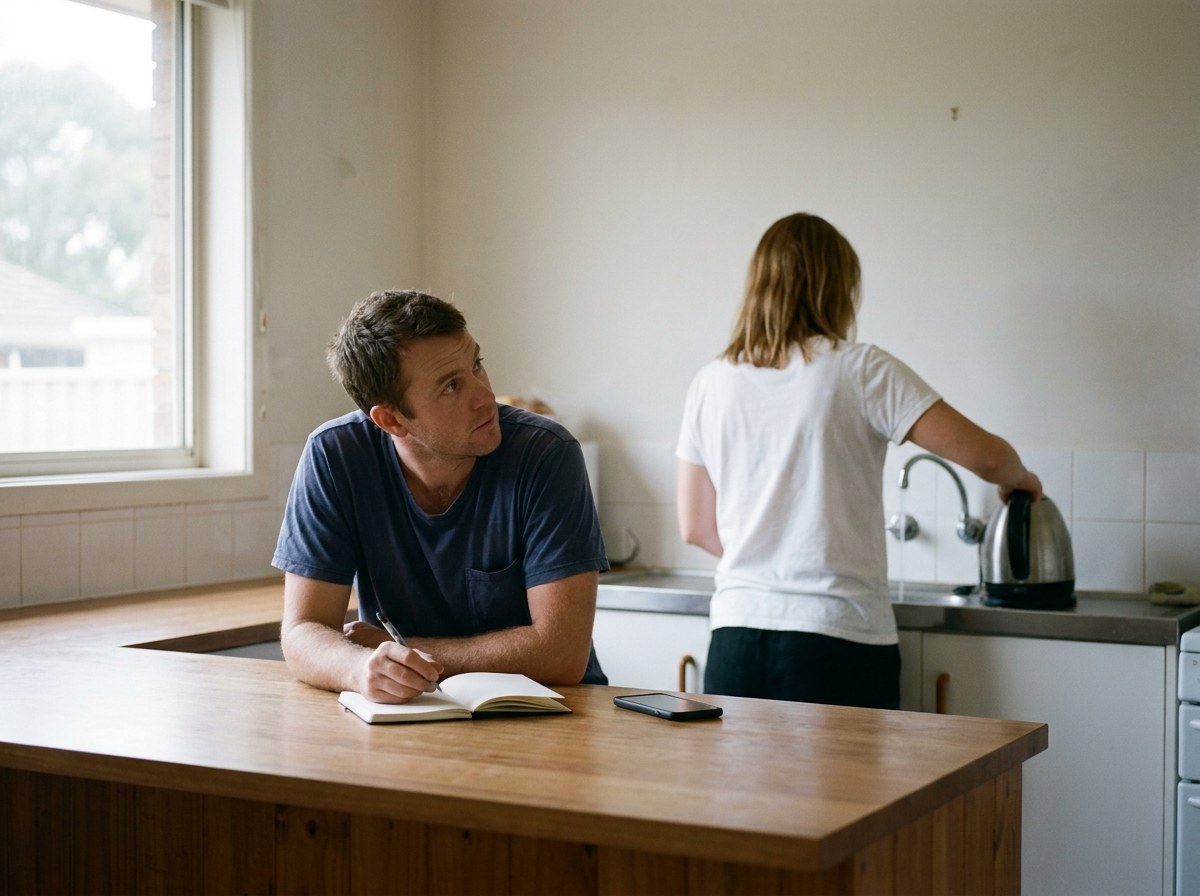
Every perimenopause tracker I found was built for her.
Symptoms, cycles, hot flushes, or hot flashes as other parts of the world call them, counted and charted. Good. She should have that if she wants it.
None of them was built for the bloke standing in the kitchen trying to work out what kind of day he'd walked into.
Is there a perimenopause tracker for husbands?
There wasn't. So I started with a pen.
Not her symptoms. Her weather. For a long time, when nothing online was written for me, I decided I'd have to work it out myself, and it started with paying attention. Really paying attention. The length of the words she spoke in. Whether I got eye contact. Her tone. How she was with the kids, which was the most reliable read in the house, because she could fake plenty around me and she couldn't fake it with them.
I didn't call it tracking. I called it reading the room. But a bloke who reads the room every morning for a couple of years ends up with a record, whether he writes it down or not.
What was I actually tracking?
The weather. That was the only way I could make sense of what I was seeing.
I could see the days when things were clearer. I could see the days that were beautiful sunshine, when she was back to herself. And I could see when it was properly stormy. So I gave the days names, the way the forecast does, and that's where our five weather patterns came from.
Storm Warning, when she's irritable and snapping at things that never used to set her off. Overcast, flat and tired and going through the motions. Fog, when she's there but nothing lands. Clearing, better but tender. Sunshine, the days she's herself.
That's it. Not nineteen symptoms. Five weather patterns, and which one is in the house. Naming the day was the first tool I ever had, and it's still the one I use most.
And they don't keep office hours. Some days there's one pattern from breakfast to bed. Some days we get all five. Sunshine at seven, Overcast by lunch, a Storm Warning at the door at six. Some patterns sit over the house for a couple of days. So the read isn't once. It's whenever I'm with her.
What did I get wrong before I tracked anything?
I walked into every morning the same way.
Same tone. Same energy. Same assumption that whatever I felt like saying was fine to say. Some mornings that was fine. Some mornings I'd walked into a room that had already changed before I got there, and I had no idea, because I hadn't read the weather. I didn't know there was weather to read.
That's the whole thing I want a bloke to take from this page. There are patterns. There are five of them. Learn the five and you get better at all of it.
A tracker, even a pen and the back of an envelope, forces you to look. It doesn't diagnose anything. Anything medical is still a doctor or a specialist in this field, and you go with her. That's all it is. A reason to check before you speak.
Why did we build an app?
Because the pen worked, and most blokes won't pick one up.
So we built The Perimenopauseologist. A pocket forecast for husbands. Five taps in the morning to read the day. One tap when it's happening, for the thirty seconds before you say the wrong thing. For each of the five patterns, what not to do, what to do, and what to say, word for word.
It's not a symptom tracker. She has those. It's the other half, the half that was never built, for the person who has to read her from across the kitchen.
We built it for the bloke who doesn't get it yet. We also built it for her, because most blokes will never go looking for a thing like this. If you're the one reading this and you want help at home, this is something you can hand him.
The founding list is open at theperimenopauseologist.com. I'll say plainly that it's ours, and that I'd rather you learned to read the room with a pen than never learned at all. The app just makes it harder to skip.
Where do I start tonight?
Here's one of the tools. There are plenty.
One word a day, for a fortnight. Which of the five weather patterns was it today.
Here's what that means in practice. Tonight, before you go to sleep, write down one word. Storm Warning, Overcast, Fog, Clearing or Sunshine. Have the list of the five next to you until you know them. Ask yourself what the forecast was this morning, and whether it changed through the day. If it did, write the one that mattered most. Nothing else. No notes on what she said or did. No scoring. Keep it to yourself.
Do that every night for a fortnight. Get good at reading which pattern is in the house. That's the skill, and it's the only one you need to start with.
After a fortnight you'll have something nobody handed you. A picture of the weather in your own house. You'll see that the hard days come in runs. You'll see that the question you asked on Tuesday landed badly because Tuesday was Fog.
Then, if you want, the app keeps the record for you. It logs the fortnight, then the month, then keeps going, so you can see whether the Storm Warning days bunch up at a certain time, and whether that lines up with anything else going on in her life. You'll get better at this. But the word comes first. It always did.
What I do with the read once I've got it, the morning check and the lights out check and the ones in between, is in the book. The chapter is called Reading the Room.
Does tracking actually help?
It didn't fix anything. Nothing fixes the weather.
What it did was stop me walking into it blind. I knew what kind of day it was before I opened my mouth, and that one change took more heat out of our house than any single thing I said.
What to ask her once you've read the day is the next post. Read first. Then ask.
Start With the Weather
The Weather Report is the two-page guide to reading these days: telling a storm warning from an overcast day from a fog day, and knowing the one thing to do in each. Free, on your phone in thirty seconds.